Wall tie failure: the signs, the causes and who is at risk
Wall tie failure is slow, but it does not stop on its own. Here is what it looks like, why it happens, and the problems that are easy to mistake for it.
The classic sign of wall tie failure is horizontal cracking in the mortar joints at regular heights, often about every sixth course. Other signs are bulging brickwork, cracks around windows and doors, and the outer wall lifting at the roof line. Some ties fail with no visible signs at all.
Signs of wall tie failure
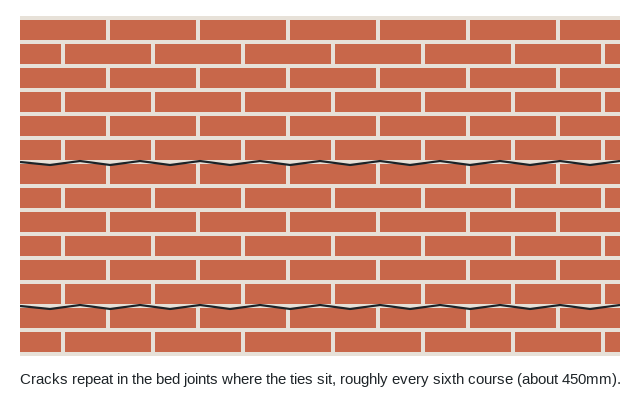
Horizontal cracks in the mortar
Along the bed joints at regular heights, about every sixth course (row of bricks), where the ties sit.
Bulging or bowing brickwork
The outer leaf leaning out once it loses its restraint.
Cracks at windows and doors
Openings have extra ties, so movement often shows here first.
Lifting at the roof line
Swelling ties raise the outer leaf so it pushes up under the eaves or verge.
Gable wall movement
Tall gables catch the most wind and often show failure first.
Rust staining
Brown or orange marks bleeding from the mortar joints.
Check the most exposed walls first: the ones facing the prevailing wind and rain, usually south-west in much of the UK. On a rendered house, cracks in the render can hide the pattern or imitate it, so patching the render does not settle the question.
Seen these signs? A wall tie survey confirms whether the ties are the cause.
How urgent is it?
Wall tie failure usually develops over years, not weeks. If you have seen the signs, get a survey within the next few months rather than waiting for things to get worse.
Caught early, most of the cost of replacing failed wall ties is the ties and repointing. Left until the wall bows, it can mean rebuilding.
Get someone out straight away if bricks are loose, the wall is visibly bulging, or cracks are getting wider quickly, especially on a tall gable or above a path.
When there are no signs
Wire ties, such as butterfly and double triangle ties, do not swell much as they rust. They get thinner until they snap, and the wall can look perfect while the outer leaf is barely held. This is why a wall with no cracks can still fail a survey, and why age and exposure matter as much as what you can see.
Why wall ties fail
Almost every failure comes down to corrosion of steel ties.
- Thin galvanising. The zinc coating required on steel ties was increased in 1981. Ties from before then often had too little to last the life of the house.
- Moisture. The end of the tie in the outer leaf sits in masonry that gets wet every time it rains. Exposed, coastal and hillside sites see the fastest corrosion.
- Aggressive mortar. Black ash mortar, made with ash from furnaces and common in former industrial areas, is acidic and strips the zinc faster.
- Rust expansion. Rust takes up at least twice the volume of the steel it replaces. On strip ties this jacks the mortar joint open.
Is your house at risk?
The houses most likely to have failing ties share a few traits:
- Cavity walls built before about 1981, and especially between the 1920s and the 1970s
- An exposed position facing the prevailing wind and rain
- Dark, ashy mortar
- Past damp problems, poor pointing or blocked weep holes
Solid-walled houses have no cavity and no ties. If your walls are about 225mm (nine inches) thick and the brick pattern shows short brick ends (headers) as well as long faces, the wall is probably solid.
What looks like wall tie failure
Not every horizontal crack means failed ties. These can look similar, which is why diagnosis needs a look inside the cavity:
| Problem | How it differs |
|---|---|
| Sulfate attack | Sulfates in the bricks or ground react with the mortar and make it swell. Cracks show in many joints, not just tie courses, and mortar often crumbles. |
| Subsidence or settlement | Cracks are mostly diagonal or stepped, wider at one end, and often run through bricks as well as joints. |
| Thermal or shrinkage movement | Usually vertical cracks in long runs of wall, often at regular intervals along the length. |
| Corroding lintels | Cracking and lifting is local to the brickwork over a window or door. |
Wall ties and cavity insulation
Insulation does not cause wall tie failure, but the two share the same gap. Insulation that has got wet, through failed pointing or a cavity bridged with debris, keeps moisture in the cavity for longer and speeds up corrosion. Corroded ties are also often found when insulation is installed or extracted.
Buying a house where the survey mentions wall ties? See what to do next.
If you are having cavity insulation removed, it is a sensible moment to have the ties checked.
Questions people ask
What are the first signs of wall tie failure?
Thin horizontal cracks in the mortar joints at regular heights, often about every sixth course, usually seen first on exposed elevations and tall gable walls.
Is wall tie failure dangerous?
It is progressive. Left alone, the outer leaf loses its restraint and can bulge and, in severe cases, collapse, particularly in high winds. Caught early, it is a routine repair.
Which houses are most at risk?
Cavity-walled houses built before about 1981, especially on exposed sites facing the prevailing wind and rain, and walls built with black ash mortar.
Can wall ties fail without any cracks?
Yes. Wire ties such as butterfly ties corrode thin and snap without swelling, so a wall can lose its ties with no visible cracking. Only an inspection inside the cavity confirms it.
Does cavity wall insulation cause wall tie failure?
Not on its own. But insulation that has become wet holds moisture in the cavity for longer, which speeds up corrosion of steel ties.