Wall tie replacement cost: typical prices and what drives them
Two houses that look alike can have very different bills. Here is what moves the price, what a fair quote should spell out, and how to compare quotes like for like.
Checkatrade's cost guide, updated September 2026, puts wall tie replacement at £5 to £8 per tie, or £30 to £50 per square metre of wall. The real price of your job depends mainly on how much wall needs new ties, whether the old ties must be cut out or can simply be isolated, access, and repairs to the brickwork. A single elevation with isolated wire ties is a far smaller job than a whole house with expanding strip ties to remove.
Typical wall tie replacement prices
Checkatrade's cost guide, updated September 2026 and checked by its estimators, gives these ballpark averages.
Cost per tie and per square metre
| Item | Typical range |
|---|---|
| Per wall tie replaced | £5 to £8 |
| Per square metre of wall | £30 to £50 |
Treat these as a starting point, not a quote. Scaffolding, removing old ties and brickwork repairs are priced separately in most quotes, and they can cost more than the ties themselves. So is any work on damp, such as clearing mortar-bridged ties or extracting wet cavity insulation.
Wall tie survey cost
The same guide puts a full wall tie survey at £250 to £450. Some installers survey for free when they quote. An independent structural engineer always charges, and is worth paying for when the diagnosis is unclear or two installers disagree.
What drives the cost of replacing wall ties
Use this table to make sure every quote you get describes the same job.
| Factor | Why it matters |
|---|---|
| Wall area | Ties go in at about two and a half per square metre, so a detached house has far more ties to fit than a mid-terrace with two outside walls. |
| Which walls | Failure is sometimes confined to the most exposed outside walls (elevations). Tying only the walls that need it costs less than tying the whole house. |
| Masonry | Soft, hollow or unusual masonry may need resin-bonded ties, which cost more than mechanical or helical ones. |
| Render or cladding | Ties fitted through render need the holes made good in a matching finish. |
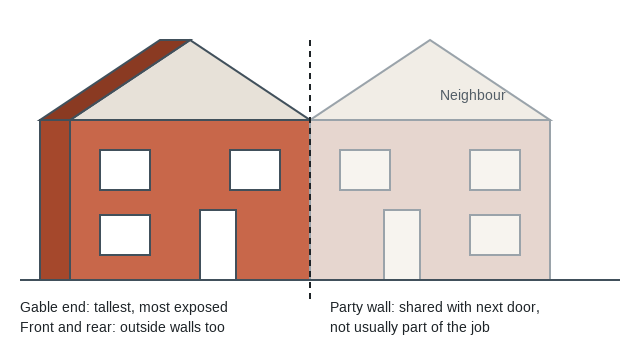
Wall tie replacement cost by house type
House type changes how much outside wall there is, and how it is reached. Here is how each usually compares.
Terraced house
A mid-terrace has only its front and rear walls to tie, so it is usually the smallest job. An end terrace adds a gable wall, which makes it closer to a semi.
Semi-detached house
Front, rear and one gable end. The gable is the tallest and most exposed wall, often the first to fail, and usually needs scaffolding to reach the top.
Detached house
Four outside walls, often with two gables, so the most ties and the most scaffolding. It is also the type most likely to have failure on some walls but not others, so ask which walls actually need work.
Bungalow
Low walls can often be done from towers or ladders rather than full scaffolding, which keeps access costs down.
Extra costs to check in a quote
Removing old wall ties
Isolating wire ties is quick. Removing expanding strip ties means cutting out and replacing bricks at every tie, so it is slow and adds a lot to the bill. See when old ties need removing.
Scaffolding
Two-storey walls and gables usually need scaffolding. Check who arranges it, how long it is booked for, and whether it is in the price.
Repointing and crack stitching
Cracked joints need raking out and repointing. Wider cracks may need stainless steel bars bonded across them (crack stitching).
Rebuilding bowed brickwork
Where the outer leaf has bowed too far to be restrained, sections are taken down and rebuilt. This is the most expensive part of any wall tie job, and the reason not to leave signs of wall tie failure too long.
What a wall tie replacement quote should include
- Which elevations are included, and why the others are not
- The number of new ties, the tie type and the spacing
- How the old ties will be dealt with: isolated or removed, and how many of each
- Access: scaffolding, who arranges it and for how long
- Repairs: repointing, crack stitching or rebuilding, itemised
- The guarantee: its length, whether it is insurance-backed and whether it transfers to a buyer
- Whether VAT is included
Comparing wall tie quotes
Quotes for wall tie work often differ because they describe different jobs. Before you compare prices, check they cover the same walls, the same treatment of the old ties and the same repairs. A cheap quote that isolates strip ties which ought to be removed is not a saving: the brickwork will keep moving.
If two installers disagree on whether the ties have failed at all, an independent structural engineer's report settles it.
The cost of leaving failed wall ties
Wall tie failure gets worse, not better. Early on, the work is mostly new ties and repointing. Once the outer leaf has bowed, sections may need taking down and rebuilding, which costs far more than the ties themselves. Unresolved wall tie problems can also hold up a house sale when a buyer's surveyor finds them.
Questions people ask
How much does wall tie replacement cost?
Checkatrade's cost guide, updated September 2026, puts it at £5 to £8 per tie, or £30 to £50 per square metre of wall, with a full survey at £250 to £450. These are ballpark averages: the price of your job depends on the factors on this page.
What affects the cost of wall tie replacement most?
The area of wall to be tied, whether old strip ties have to be removed rather than isolated, whether scaffolding is needed, and how much brickwork needs repairing.
Is removing old wall ties more expensive than isolating them?
Usually, yes. Removing an expanding strip tie means cutting out the brick around it and rebuilding, which takes far longer per tie than cutting a wire tie back.
Do I need to replace the ties on every wall?
Not always. A survey may find failure on one or two exposed elevations only. Ask the surveyor to say which walls are affected and why.
Does a wall tie survey cost money?
Some installers survey for free when they quote, others charge. An independent structural engineer's report is always charged for, and is worth having when the diagnosis is unclear or there is a dispute.
Does home insurance cover wall tie failure?
Usually not. Most policies treat it as gradual wear and corrosion rather than sudden damage. Check your own policy wording.