Wall tie replacement: the survey and how the work is done
Failed wall ties can almost always be replaced from outside, without taking the wall down. Here is what a proper survey covers and what the work involves, step by step.
Wall tie replacement means fixing new stainless steel ties through the outer leaf into the inner leaf, then isolating or removing the old ties. It is done from outside, usually in a few days, and starts with a survey to confirm the ties have actually failed.
The wall tie survey
A wall tie survey answers one question: are the ties still doing their job? In most houses built before 1981 the original ties are galvanised steel, so the surveyor is looking for how much of the zinc coating, and then the steel, has corroded.
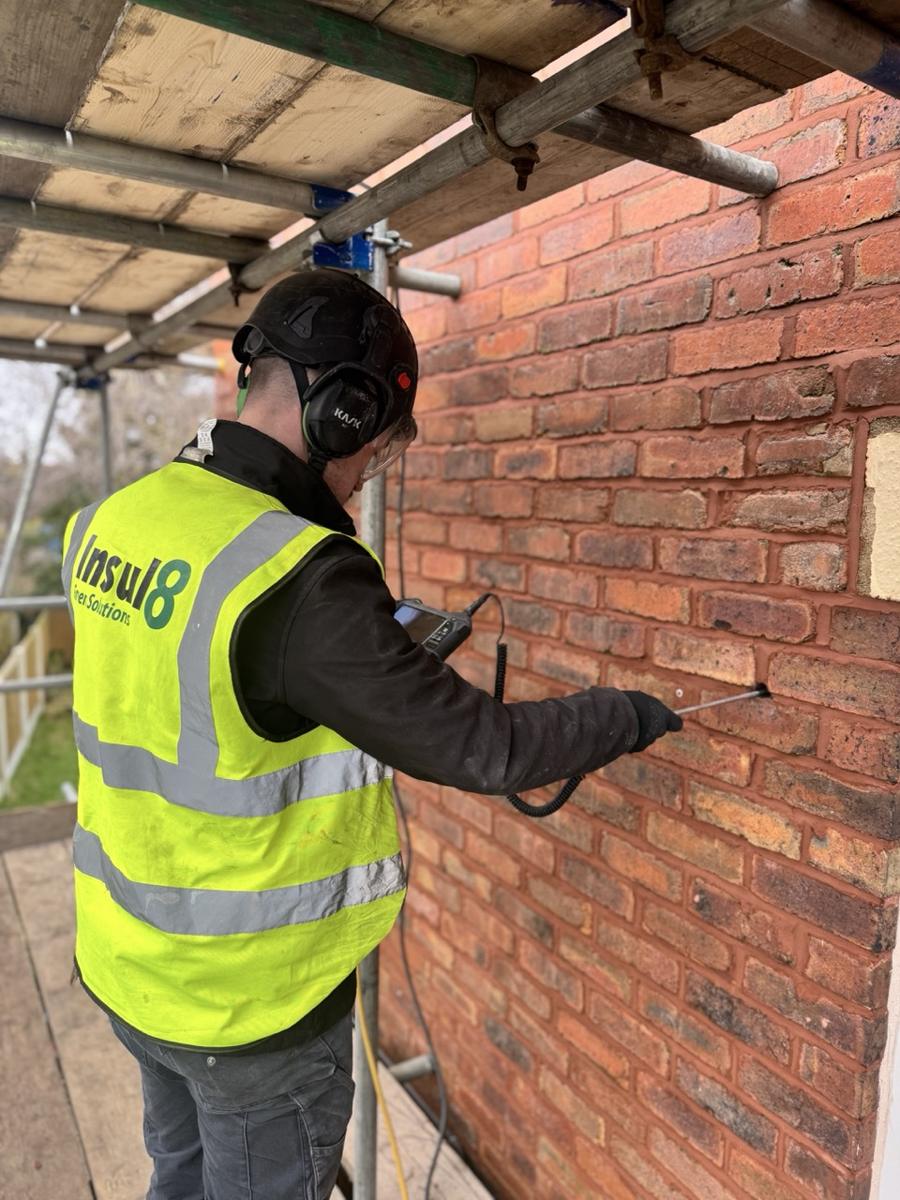
What the surveyor checks
A competent surveyor will usually:
- Look at every outside wall (elevation) for horizontal cracking, bulging and movement at the roof line.
- Use a metal detector to find the ties and check how many there are and how they are spaced.
- Drill small holes and look into the cavity with a borescope to see the type and condition of the ties.
- Where needed, take out a brick to expose a tie fully.
- Tell you in writing whether failure is confirmed, suspected or ruled out, which walls are affected, and what work is needed.
Damp and wall ties
Damp patches on inside walls are not usually caused by failed ties. But ties caught with mortar droppings can carry rain across the cavity to the inner leaf, and wet or slumped cavity insulation can do the same. A good survey notes any bridged ties or wet insulation, as both are cheaper to deal with while the scaffold is up.
Homebuyer surveys and wall ties
A homebuyer survey, such as a RICS Level 2 or Level 3 survey, may flag possible wall tie problems. It will usually recommend a specialist inspection rather than confirm the diagnosis.
How wall tie replacement works
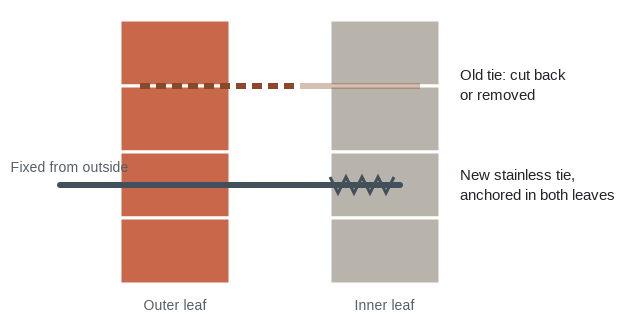
The method follows the Building Research Establishment's guidance in BRE Digest 401, Replacing wall ties, and BRE Digest 329, Installing wall ties in existing construction.
- Set out. The new tie positions are marked to the required spacing, with extra ties beside openings and at the top of the wall.
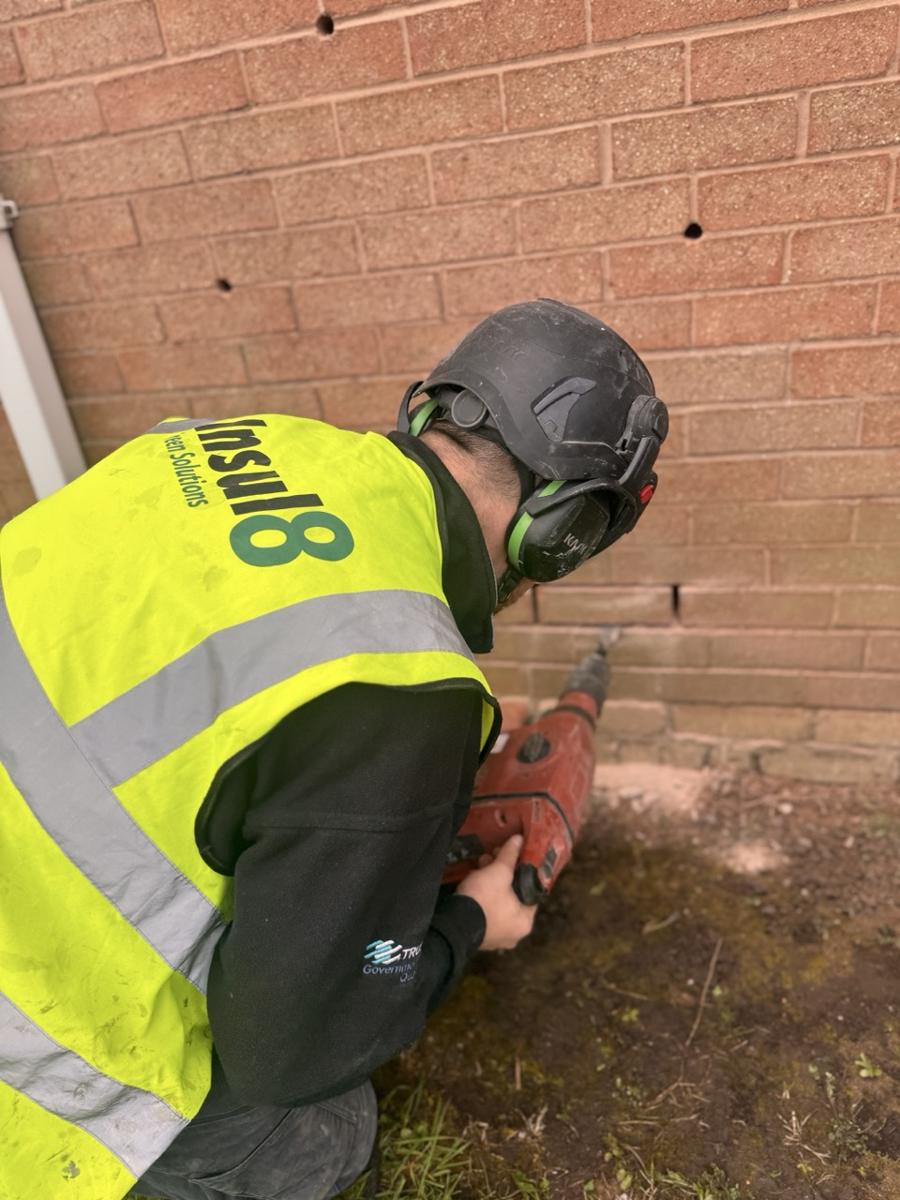
- Fit new ties. Holes are drilled through the outer leaf into the inner leaf, and stainless steel remedial ties are fixed: helical, mechanical expansion or resin-bonded, depending on the masonry. See types of remedial tie.
- Test. A sample of ties is usually pull-tested to check they are holding in the inner leaf.
- Deal with the old ties. Isolated or removed, as below.
- Make good. Drill holes are filled and the joints repointed in a mortar matched to the existing colour.
- Hand over. You should get a record of the work and a written guarantee.
If the cavity is insulated, the installer should tell you whether it affects the work. Wet or failed insulation may need extracting first.
Isolate or remove the old ties?
| Old tie | Usual treatment | Why |
|---|---|---|
| Wire (butterfly, double triangle) | Isolated: cut back so the outer end no longer bridges the cavity | Wire ties do not swell much, so they cannot crack the wall further |
| Strip (vertical twist), expanding | Removed, usually by cutting out the brick around each tie | Left in place, the rust keeps jacking the brickwork apart |
Repairs to the brickwork
Where the outer leaf has cracked or bowed, new ties alone are not always enough. Repairs are often the biggest part of the cost of replacing wall ties.
Repointing
Cracked joints are raked out and repointed in a matching mortar.
Crack stitching
Stainless steel bars are bonded into the joints across wider cracks to tie the brickwork back together.
Rebuilding bowed brickwork
Sections that have bowed too far to be restrained are taken down and rebuilt with new ties.
Buying a house and the survey mentions wall ties
This is how many people first hear about wall ties. A homebuyer survey that says "possible wall tie failure" is a warning, not a diagnosis.
- Get a specialist wall tie survey before you exchange contracts. Once you have exchanged, the problem is yours.
- Ask the seller whether the ties have been replaced before, and for any guarantee. A transferable guarantee may already cover the work.
- Tell your lender. Some lenders hold back part of the mortgage until the work is done, or ask for a specialist report first.
- Use the quote. A written quote for the work gives you a figure to negotiate the price with.
- Get a second opinion if it matters. Two quotes, or an independent structural engineer's report if the installers disagree.
Choosing an installer
- Trade body membership: the Wall Tie Installers Federation (WTIF) and the Property Care Association (PCA) both have member directories and codes of practice.
- An insurance-backed guarantee: one that still pays out if the installer stops trading, and that passes to a buyer.
- A written survey first: be wary of a quote given from the pavement with no look inside the cavity.
- Listed building or conservation area: check with your local planning authority before work starts. Drilling and repointing visible brickwork on a listed building may need listed building consent.
- A clear scope: which walls, how many ties, how old ties are dealt with, and what repairs are included.
Questions people ask
Can failed wall ties be replaced without rebuilding the wall?
In most cases, yes. New stainless steel ties go in from outside and the old ties are isolated or removed. Rebuilding is only needed where the outer leaf has moved too far to be restrained.
Do old wall ties have to be removed?
Not always. Wire ties are usually isolated by cutting them back. Strip ties that are expanding are usually removed, because left in place they keep pushing the brickwork apart.
How long does wall tie replacement take?
For a typical house, a few days. It depends on the area of wall, how many old ties need removing, whether scaffolding is needed and whether any brickwork needs rebuilding.
Will I need to move out?
No. The work is done from outside. Expect drilling noise and some dust near windows.
Will wall tie replacement affect selling my house?
Buyers' surveyors often look for evidence of wall tie problems. A record of the work and a transferable guarantee usually helps a sale rather than hinders it.